Views: 500 Author: Curry Publish Time: 2026-06-26 Origin: https://www.microductcoupler.com/


Keeping a fiber optic microduct network reliable over the long term requires more than proper installation. Underground conditions gradually affect connector performance, making environmental resistance and routine inspection just as important.
In Parts 1 and part2, we covered connector design, sealing performance, locking mechanisms, and installation mistakes. Now focuses on the long-term challenges of underground deployment, including environmental aging, material degradation, and the practical inspection methods technicians use to locate and diagnose connector failures.

Microduct connectors are designed to protect fiber pathways for decades. However, underground environments expose them to continuous chemical, thermal, and mechanical stress. Over time, these conditions can weaken connector materials, reduce sealing performance, and eventually lead to failure.
Understanding these factors helps network operators select suitable products and develop effective maintenance plans.
Low temperatures cause plastic connector bodies and elastomer O-rings to contract and lose flexibility. Repeated expansion and contraction during temperature changes may create microscopic sealing gaps or make the housing more brittle, increasing the risk of cracking under external loads.
Highly acidic or alkaline soil can accelerate the aging of polymer materials. Over years of underground exposure, aggressive groundwater may gradually weaken micro duct fitting components and reduce the strength of the locking mechanism.
High groundwater levels place continuous pressure on connector seals. At the same time, hydrocarbons, oils, or industrial chemicals carried by runoff may attack elastomer O-rings, causing them to swell, soften, or lose elasticity, eventually compromising the seal.
Telecom duct connectors installed beneath roads or near heavy traffic experience constant vibration and repeated loading from vehicles and pedestrians. Although each load is relatively small, long-term cyclic stress can cause material fatigue, blown fiber tube connector movement, or gradual joint loosening.
When a fault occurs in a buried microduct network, locating the exact failure point quickly is essential. Instead of excavating large sections of the route, technicians use systematic testing methods to narrow down the affected area and identify the root cause.
The following inspection techniques are widely used during field troubleshooting.
Air pressure testing is the most common method for checking duct integrity. Compressed air is introduced at one end of the duct while technicians monitor pressure stability and pressure loss at the opposite end.
The observed pressure behavior often reveals the type of failure.
Observed Pressure Behavior | Likely Cause |
|---|---|
Normal pressure at the inlet, but a significant pressure drop at the outlet | Air leakage in the middle or downstream section of the duct |
System cannot build pressure | Major leakage caused by a disconnected connector or damaged duct |
Pressure builds normally but gradually decreases | Small leak caused by a damaged O-ring or a hairline crack |
Pressure fluctuates during testing | Loose DB micro duct connector or leak that opens only under certain pressure levels |
Pressurized air escaping from a damaged HDPE micro duct end coupler produces distinctive sounds. Ground microphones or acoustic leak detectors help technicians locate and classify leaks based on these sound patterns.
Acoustic Characteristic | Likely Cause |
|---|---|
Soft, high-frequency hissing | Small air leak |
Loud, continuous rushing sound | Major connector failure or housing crack |
Intermittent leak noise | O-ring displacement or twisting under pressure |
Vibration accompanied by leak noise | Loose connector or partially detached duct |
For long duct routes, pressure readings alone may not identify the exact fault location.
The Segmental Isolation Method divides the route into smaller test sections. Each section is tested independently, allowing technicians to gradually narrow the problem to a specific direct buried micro duct connector or duct segment. This approach significantly reduces troubleshooting time and unnecessary excavation.
Where access fiber optic chambers, handholes, or open trenches are available, internal visual inspection provides direct evidence of the duct's condition.
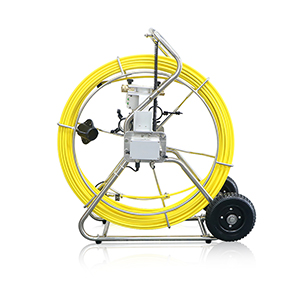
A push-rod endoscope inserted into an empty HDPE microduct allows technicians to inspect the internal pathway in real time.
Typical observations include:
Endoscope Observation | Interpretation |
|---|---|
O-ring flipped or twisted out of its groove | Installation error, usually caused by an unchamfered duct |
Scratches or gouges on the duct wall | Manufacturing defects or excessive friction during handling |
Water inside the duct | Seal failure allowing groundwater intrusion |
Sand, mud, or debris inside the duct | Contamination introduced during installation |
Offset at the connector joint | Connector misalignment during assembly |
A calibrated Go/No-Go rod or mandrel is pushed or blown through the duct to verify that the pathway is suitable for fiber blowing.
The resistance encountered helps identify mechanical problems.
Test Result | Likely Cause |
|---|---|
Rod stops completely | Severe blockage or crushed duct |
High resistance throughout the connector | Internal connector misalignment |
Repeated sticking or dragging | Duct ovality or deformation |
Rod consistently stops at one location | Localized duct collapse or external damage |
Push-fit microduct connector failures are rarely caused by a single event. More often, they result from years of environmental exposure combined with small installation defects that gradually worsen over time.
Routine air pressure testing, acoustic leak detection, segmental isolation, and internal endoscope inspections allow technicians to identify problems early, minimize unnecessary excavation, and perform targeted repairs. Combined with high-quality micro duct connectors and proper installation practices, these inspection methods help maximize network reliability and extend the service life of fiber optic infrastructure.
At FCST, we manufacture top-quality microduct connector, microduct closure, telecom manhole chambers, Warning Nets and Locators and fiber splice boxes since 2003. Our products boast superior resistance to failure, corrosion, and deposits, and are designed for high performance in extreme temperatures. We prioritize sustainability with mechanical couplers and long-lasting durability.
FCST, aspires to a more connected world, believing everyone deserves access to high-speed broadband. We're dedicated to expanding globally, evolving our products, and tackling modern challenges with innovative solutions. As technology advances and connects billions more devices, FCST helps developing regions leapfrog outdated technologies with sustainable solutions, evolving from a small company to a global leader in future fiber cable needs.