Views: 500 Author: Curry Publish Time: 2026-04-20 Origin: https://www.microductcoupler.com/


Selecting the wrong lubricant for your cable installation method can lead to increased friction, cable damage, and installation failure. While both cable pulling and cable blowing aim to install cables into ducts, their physical principles, stress points, and lubrication requirements are fundamentally different.
This article analyzes these differences from four professional perspectives: mechanical principles, lubricant rheology, application methods, and environmental & safety considerations.
Cable pulling relies on mechanical tension applied to the cable's strength members or jacket. The winch or puller creates tensile force, which must overcome friction along the entire conduit path. The primary stresses are:
Axial tension along the cable length
Radial pressure at conduit bends (sidewall pressure)
Shear stress at the cable-conduit interface
For long-distance or multi-bend pulls, friction is the primary limiting factor. Without proper lubrication, pulling tensions can exceed cable safe working limits, causing jacket damage or conductor stretch. According to Polywater's technical documentation, proper lubrication can reduce pulling tension by 50% or more.
Cable blowing (also called jetting) uses compressed air to propel cables through ducts, typically for fiber optic installations. The pushing force is applied by a blowing machine's tracked mechanism, while airflow creates a "fluidized bed" effect that reduces contact between the cable and duct wall. Primary forces include:
Compressive force from the blowing machine's tracks
Drag force from high-velocity air
Vibrational forces that help overcome static friction
The installation relies on maintaining a thin air gap around the cable. As noted in NANOG's technical discussions, "the pulling lube does not work well, the blowing lube made a huge difference" for fiber optic installations.
Pulling lubricants are typically high-viscosity gels or pastes. Their characteristics include:
Property | Pulling Lubricant Requirement | Why It Matters |
Viscosity | High (gel-like) | Stays on cable during long pulls |
Cling Strength | Strong | Doesn't drip off vertical sections |
Consistency | Thixotropic | Flows under pressure but stays put when static |
Residue After Drying | Low | Allows future cable replacement |
3M's wire pulling lubricants, for example, are formulated as "thick, non-flowing gel" that doesn't liquefy with temperature changes. This consistency ensures the lubricant stays on the cable throughout the pull.
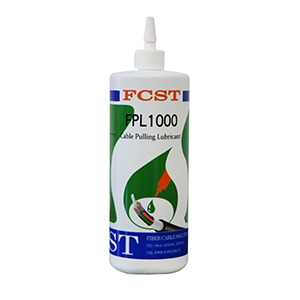
FCST FPL5000 and FPL330 are clear polymer gels with:
Coefficient of friction as low as 0.1 μ
Concentrated formula working at very low coating thickness
Low residue for easier cable replacement
Temperature stability from -5°C to 80°C
Blowing lubricants are designed differently. They must:
Be easily injectable into the duct before cable insertion
Dry quickly to form a permanent low-friction coating
Have low viscosity to spread thinly and evenly
Key differences:
Property | Blowing Lubricant Requirement | Why It Matters |
Viscosity | Low (liquid) | Can be pumped or squeezed into micro-ducts |
Drying Time | Fast (minutes) | Lubricates after installation completion |
Film Formation | Continuous thin layer | Reduces friction for entire cable life |
Residue | Non-tacky after drying | Prevents cable adhesion over decades |
According to Socomore's technical specifications, blowing lubricants typically have much lower viscosity than pulling lubricants, allowing them to be injected directly into ducts.
FCST FBL2000 is specifically engineered for cable blowing:
Milky white liquid with controlled viscosity
Concentrated formula working at very low coating thickness
Dries to a low-friction coating that continues lubricating after drying
Requires only 10-30ml per 100 meters depending on micro-duct size

Pulling lubricants are applied directly to the cable surface as it enters the duct. Common methods include:
Manual Method: Technicians apply lubricant by hand with gloved hands, spreading it evenly around the cable circumference. This also allows visual inspection of the cable jacket for defects.
Pour Method: Lubricant is poured from jugs in a zig-zag pattern across the cable top surface, with gravity flowing it around the sides.
Pump Method: Mechanical pumps deliver consistent lubricant flow, reducing waste and labor. This is preferred for large-diameter power cables.
ASTM International provides standardized test methods for evaluating cable lubricant application efficiency and friction reduction.
FCST Application Tip: For pulling applications, FCST recommends using the FPL5000 (5-gallon pail) with a manual lever pump or hydraulic piston pump. The concentrated formula requires only a thin coating, so start with the lowest flow rate and adjust as needed.
Blowing lubricants are applied directly into the duct before cable insertion. The process is simpler:
Squeeze or inject the lubricant into the duct mouth
Use a foam sponge or pig to spread it evenly (optional but recommended)
Begin cable blowing immediately
FCST FBL2000 application: simply squeeze into duct before blowing cable. The lubricant coats the duct efficiently and continues lubricating after drying.
For micro-ducts, precise dosing is critical. The International Telecommunication Union (ITU-T) has published recommendations on micro-duct cable installation practices, including lubricant application guidelines.
Both pulling and blowing lubricants have moved away from petroleum-based formulas toward water-based systems. Benefits include:
Easy cleanup with water
Non-toxic to installers and the environment
Compatible with LSZH cables (halogen-free)
No soil or groundwater pollution
The United States Environmental Protection Agency (EPA) maintains standards for environmentally acceptable lubricants, particularly for applications near water bodies.
FCST's Advantage: All FCST lubricants are water-based, non-irritating, and non-corrosive. They are safe for underground use and will not damage cable jackets.
Low Smoke Zero Halogen (LSZH) cables are common in tunnels, ships, and buildings. The lubricant must not compromise their fire performance.
Industry Concern: Some lubricants contain halogens or additives that increase smoke density or release toxic gases when burned.
The International Electrotechnical Commission (IEC) has established standards for LSZH cable performance, including IEC 60754 for gas emission testing.
FCST's Solution: FCST lubricants are halogen-free and non-corrosive. They will not degrade LSZH properties or add toxic load in a fire.
One critical question: Will lubricant residue cause cables to stick inside ducts after 20 years?
For pulling lubricants, low residue is essential. 3M advertises low residue for easier cable replacement [3]. FCST FPL5000 and FPL330 also feature "low residue for easier cable replacement."
For blowing lubricants, the dried film must remain slippery, not tacky. FCST FBL2000 provides "low-friction coating: coats duct efficiently and lubricates after drying."
The Insulated Cable Engineers Association (ICEA) provides standards for cable installation practices, including guidance on lubricant selection for long-term reliability.
Aspect | Cable Pulling Lubricant | Cable Blowing Lubricant |
Primary Force | Tension (pulling) | Compression + Airflow |
Lubricant Form | High-viscosity gel | Low-viscosity liquid |
Application Point | On cable surface | Inside duct before cable |
Drying Requirement | Not critical (wipes off) | Fast drying to form coating |
Key Performance Metric | Coefficient of friction (0.1 μ ideal) | Coating uniformity, drying time |
Residue Concern | Low solids for re-pulling | Non-tacky after decades |
FCST Product | FPL5000 (5-gal), FPL330 (330ml) | FBL2000 (25L/200L) |
Performance Gain | 30% increase in pulling speed/distance | 30% increase in blowing distance |
Large jobs (5-gallon): FPL5000 – Multi-Industry Cable Pulling Lubricant – 5-gallon capacity, µ=0.1, low residue
Small/portable jobs: FPL330 – Universal Cable Pulling Lubricant – 330ml can, same performance
Micro-duct blowing: FBL2000 – Cable Blowing Lubricant – 25L/200L, dries to low-friction coating
For additional technical guidance, The Fiber Optic Association (FOA) offers reference materials on cable installation best practices.
The difference between blowing and pulling lubricants is not marketing—it's engineering. Pulling lubricants must be high-viscosity gels that cling to cables under tension. Blowing lubricants must be low-viscosity liquids that dry into permanent low-friction coatings inside ducts.
Using the wrong type leads to installation failure, cable damage, or both. Choose based on your installation method, not price or availability.
For hybrid installations (e.g., pull + blow combinations), consult FCST's technical team for custom recommendations.
Contact FCST
Tel:+86 18720624696
Email: sales@fcst.com
Web: www.fcst.com | www.microductcoupler.com
FCST - Better FTTx, Better Life.
At FCST, we manufacture top-quality microduct connector, microduct closure, telecom manhole chambers, Warning Nets and Locators and fiber splice boxes since 2003. Our products boast superior resistance to failure, corrosion, and deposits, and are designed for high performance in extreme temperatures. We prioritize sustainability with mechanical couplers and long-lasting durability.
FCST, aspires to a more connected world, believing everyone deserves access to high-speed broadband. We're dedicated to expanding globally, evolving our products, and tackling modern challenges with innovative solutions. As technology advances and connects billions more devices, FCST helps developing regions leapfrog outdated technologies with sustainable solutions, evolving from a small company to a global leader in future fiber cable needs.