Views: 500 Author: Curry Publish Time: 2026-04-29 Origin: https://www.microductcoupler.com/


Modern cable installation spans industries as diverse as nuclear power plants and community smart grids. The one silent hero enabling safe, damage-free pulls across these sectors is the modern water-based cable lubricant. Unlike traditional petroleum-based gels, today’s advanced formulations—such as low-residue, high-efficiency fluids—offer specific friction coefficients and compatibility with sensitive jackets.
This article explores eight major application fields where choosing the right lubricant (including solutions like Polywater or Klein Tools pulling lubes) directly impacts project success.

In commercial and high-end residential decoration, pulling wires through finished walls or above false ceilings demands a low-residue lubricant. Standard soaps can attract dust, while oily gels stain carpets and drywall.
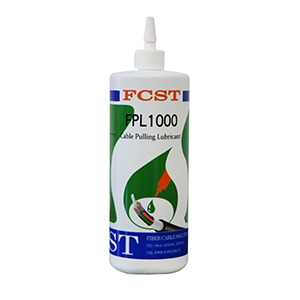
The requirement: A water-based, non-staining fluid that dries clean. For example, CRC Cable Lube is often specified for its drip-free formula. Similarly, a product like the FPL1000 Low Residue Cable Pulling Lubricant is specifically designed for these environments—its "low residue" property ensures easier cable replacement later without sticky buildup on jackets or conduit interiors.
Cities are replacing overhead lines with underground grids to improve aesthetics and weather resistance. Pulling high-voltage feeders through PVC or HDPE ducts under streets presents high friction and long-distance challenges.
The technical solution: Lubricants with an extremely low Coefficient of Friction (COF) . The FPL1000 data sheet lists a 0.1 COF , which significantly reduces winch tension. Polywater Friction Pull is an industry benchmark here, often used for pulls exceeding 1,000 feet. A 0.1 COF can increase pulling speed and distance by up to 30% , a critical factor when working on a tight city construction schedule.
Substations connect transmission to distribution. Here, cables transition from rigid busbars to underground ducts, encountering sharp bends, multiple directional changes, and mixed jacket materials (steel, aluminum, or FRP conduits).
Compatibility is key: The lubricant must be compatible with HDPE, PVC, and steel without causing jacket stress cracking (IEEE 1210 standard). 3M’s Cable Lubricant is known for its thermal stability, but water-based alternatives offer easier cleanup. Products with "compatible with HDPE/STEEL/FRP/PVC/EMT" —like the FPL1000—are ideal because a single fluid works across all those surfaces.
Nuclear facilities have the strictest fire safety and material compatibility standards. Lubricants used here must be non-flammable, halogen-free, and low-smoke, with no corrosive residue.
Regulatory concern: Many standard lubricants fail because their residue becomes conductive or corrosive under radiation. Polywater LZ is widely approved for nuclear use because it passes flame spread tests. Any water-based competitor must similarly guarantee no halogens and a pH-neutral residue. Low-residue formulas are preferred because they minimize contamination in containment zones.
Factories and mines have aggressive environments: oil, dust, temperature swings, and heavy vibration. Internal feeders often run through crowded cable trays and metallic conduits that can abrade insulation during pulls.
The focus: Extreme pressure durability and cling. Klein Tools Cable Lube offers a tacky gel for vertical runs. However, water-based lubricants like the FPL1000 provide a concentrated formula that works at very low coating thickness, preventing dripping onto factory floors while still offering a 30% increase in pulling speed. This reduces downtime during plant retrofits.
Petrochemical or water treatment plants often route instrument and control cables along elevated pipe racks. These pulls are long, exposed to weather, and prone to lubricant drying out.
The challenge: Water-based lubricants can evaporate in sun or wind, losing effectiveness halfway. Phillips 66 Cable Lube is petroleum-based to resist wash-off, but many modern water-based additives now include humectants to slow drying. For elevated work, a concentrated lubricant (like the FPL1000’s "works at very low coating thickness" ) reduces the volume needed, minimizing the drying risk.
Fiber optics are the backbone of 5G and broadband. Unlike copper, glass fibers cannot tolerate high tension. Lubrication must provide ultra-low friction without micro-bending the fiber. Both blowing (air-assisted) and pulling methods require distinct lubricant viscosities.
Industry standard: Polywater SPY is a benchmark for thin-film fiber lubricants. For traditional pulling, the lubricant must not swell the aramid yarn or soften the tight buffer. The FPL1000’s 0.1 COF is low enough for fiber pulls, and its low residue ensures that future mid-span access (splicing) is not contaminated by sticky gels.
In factories that build excavators, wind turbines, or ship engines, workers pull pre-cut cable harnesses through machine frames and articulated arms. Spaces are tight, sharp-edged, and often vertical.
The requirement: User-safe, non-skin-irritating formula with temporary lubrication. OEMs prefer water-based lubricants because they can be easily wiped off after assembly, leaving no residue that attracts debris. CRC SL3590 is often used, but any non-hazardous, low-residue water-based lube works. The benefit of a concentrated formula is that workers need less spray to coat the entire length, reducing waste and cleanup time.
Across all eight sectors, water-based cable lubricants offer three universal advantages:
Compatibility: They don’t attack polyethylene (PE) or PVC jackets.
Safety: Non-flammable and low-fume during installation.
Cleanup: Wash away with water, leaving no sticky, dirt-attracting film.
Products like Polywater lead the premium market, but advanced manufacturers such as FCST (with their FPL1000 series) prove that low-residue, 0.1-COF, concentrate-level performance is accessible for large-scale contractors—from urban grid upgrades to nuclear plant maintenance.
Final Tip: Always verify that your chosen lubricant meets the IEEE 1210 standard for cable jacket compatibility, regardless of the application field.
The use of lubricants is never arbitrary; choosing the right lubricant is crucial for engineering projects. Learn more about how to comprehensively consider various factors and select the most suitable product .
FCST - Better FTTx, Better Life.
At FCST, we manufacture top-quality microduct connector, microduct closure, telecom manhole chambers, Warning Nets and Locators and fiber splice boxes since 2003. Our products boast superior resistance to failure, corrosion, and deposits, and are designed for high performance in extreme temperatures. We prioritize sustainability with mechanical couplers and long-lasting durability.
FCST, aspires to a more connected world, believing everyone deserves access to high-speed broadband. We're dedicated to expanding globally, evolving our products, and tackling modern challenges with innovative solutions. As technology advances and connects billions more devices, FCST helps developing regions leapfrog outdated technologies with sustainable solutions, evolving from a small company to a global leader in future fiber cable needs.