Views: 500 Author: Curry Publish Time: 2026-04-23 Origin: https://www.microductcoupler.com/


In fiber optic cable blowing (jetting), wire & cable lubricant isn't an accessory — it's a performance multiplier. Use it correctly: you get 30% longer installation distances, faster speeds, and lower fiber strain. Get it wrong: stuck cables, sticky residues, or even fiber damage.
Based on FCST’s field experience with FBL2000 and FBL1000 blowing lubricants, this guide provides actionable steps for consistent, trouble-free blowing.
Cable blowing relies on compressed air to propel the fiber through a microduct. Communication cable lubricant reduces friction between the duct wall and the cable sheath.
Without lubricant: friction coefficient >0.5 — you may not make it past 200 meters before stalling.
With a quality blowing lubricant: friction coefficient drops to <0.1 — blowing distances well beyond 1,000 meters (with proper duct size and air pressure).
Key specs (FBL series): Viscosity 160±10 MPa/s, pH 5.5–7.5 (neutral). Compatible with HDPE, PVC, steel-PE composite ducts, and more. Water-based, leaves a dry film — no dust attraction, no sheath corrosion.
Too little → high friction, risk of stalling.
Too much → waste, excess liquid can block ducts or contaminate splice points.
Recommended dosage per 100 meters of microduct (FBL2000/FBL1000):
Microduct Size (OD/ID, mm) | Dosage per 100m (ml) | Typical Use Case |
|---|---|---|
14/12 mm | 30 ml | Backbone / feeder, long-distance blowing |
12/10 mm | 23 ml | Feeder or distribution sections |
10/8 mm | 17 ml | Distribution, common in FTTH |
8/6 mm | 13 ml | Drop section, more bends |
7/5 mm | 13 ml | High-density drop |
5/3.5 mm | 10 ml | Last-mile butterfly cable |
Quick rule of thumb: For every 2mm increase in inner diameter, add roughly 5–7ml per 100 meters. On site, start with the middle value, then listen to the blowing sound and watch the speed — adjust as needed.
Real-world example: An FTTH project requires blowing 500 meters of 12/10mm microduct. Theoretical dosage = 23 ml × 5 = 115 ml. One bottle of FBL1000 (1000ml) can handle roughly 4,300 meters of the same duct size.
Blowing lubricant should be applied to the inner duct wall or cable surface — never just poured into a fiber optic manhole.
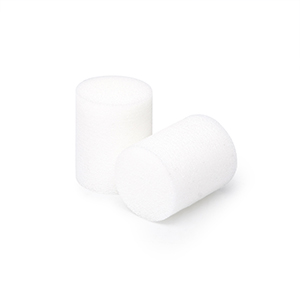
Method 1: Foam Sponge Plug
Cut foam cylinder 10–15% larger than ID. Inject lubricant, pull sponge through duct. Pros: even coating, minimal waste. Cons: multiple ops for long runs.
Method 2: Direct Injection
Inject lubricant into duct opening while blowing starts (use blowing machine port). Pros: fast, multi-km capable. Cons: dosage control takes experience.
Method 3: Pre-coating the Cable
Pull cable through sponge/brush trough with lubricant before entering duct. Pros: lubricant exactly on cable. Cons: setup needed, possible residue.
FCST recommendation: For ducts 10/8mm and smaller, use Method 1 (sponge plug) or Method 2 (direct injection). For larger ducts (14/12mm and above), Method 3 works well.
Symptom | Root Cause | Fix |
|---|---|---|
Cable stops mid-way | Insufficient lubricant or dry spot | Re-apply at 110% dosage; consider sectional blowing (relay every 500m) |
Fluctuating speed / unusual noise | Uneven coating | Switch to sponge plug method; check for sand or joint steps |
White residue on cable | Over-application | FBL series is fast-drying — residue evaporates within 24h; wipe excess with dry cloth |
Lubricant leaks out far end | Severe over-dosage | Reduce to 70% of recommended amount; clean leakage to avoid contamination |
Cable sheath soft/sticky | Wrong Cable Jet Lube (petroleum/solvent-based) | Stop immediately. Clean cable with mild neutral cleaner. Use water-based blowing lube (FBL2000) |
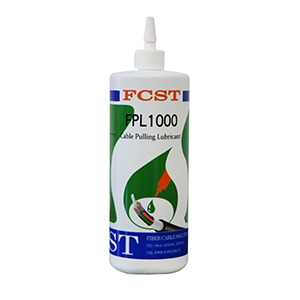
Critical warning: Do not use pulling lubricants (e.g., FPL series) for cable blowing. Pulling lubes are more viscous and slower to dry. Residue attracts dust and dramatically increases friction for future blowing.
While FCST’s German residential low-voltage cable pulling project (using FPL1000 pulling lubricant) is a pulling application, the efficiency leap it demonstrates applies equally to blowing:
Before lubricant: Pull 20m cable → 15 workers, 50 minutes.
With FCST lubricant: Same 20m → 12 workers, only 20 minutes.
Labor saved: 20% Time saved: 60%
Translating to blowing: with FBL2000, correct dosage, and proper application, multiple FTTH projects have seen blowing speeds increase from 20 m/min to over 50 m/min, and maximum single-shot distances extend from under 300 meters to 800–1,200 meters.
For the most common 10/8mm duct (17ml per 100m), one bottle covers roughly 5,880 meters. Accounting for on-site waste, expect about 5,000 meters.
Identical formula. FBL1000 is a 1-liter bottle for small projects or trials. FBL2000 is a 5-gallon (approx. 19kg) pail for bulk use. A 200L drum is also available for large-scale jobs.
Never dilute it. FBL series is ready-to-use. Dilution destroys the lubricating film and renders the product ineffective.
The recommended operating range is 0–50°C (32–122°F). If working below 0°C, store the lubricant indoors at 5–30°C (41–86°F) and only take out small amounts for immediate use. Avoid leaving the container outside to freeze.
No. FBL series is neutral and water-based, with no corrosive effect on ceramic ferrules or plastic housings. However, avoid getting lubricant directly inside connectors. A best practice is to blow cables first and install connectors afterward.
Need technical support or a free sample?
Contact FCST team:
sales@fcst.com | +86 187 2062 4696 | www.microductcoupler.com
At FCST, we manufacture top-quality microduct connector, microduct closure, telecom manhole chambers, Warning Nets and Locators and fiber splice boxes since 2003. Our products boast superior resistance to failure, corrosion, and deposits, and are designed for high performance in extreme temperatures. We prioritize sustainability with mechanical couplers and long-lasting durability.
FCST, aspires to a more connected world, believing everyone deserves access to high-speed broadband. We're dedicated to expanding globally, evolving our products, and tackling modern challenges with innovative solutions. As technology advances and connects billions more devices, FCST helps developing regions leapfrog outdated technologies with sustainable solutions, evolving from a small company to a global leader in future fiber cable needs