Views: 500 Author: Site Editor Publish Time: 2025-11-28 Origin: Site
In every fiber deployment project, there comes a moment when engineering meets unpredictability: a long microduct stretches forward—tight, dark, and full of hidden bends. Compressed air begins its controlled surge, and a fragile fiber cable is pushed into motion. Whether the cable reaches 300 meters or 2 kilometers before slowing down is determined not by chance, but by forces that installers cannot see.


Inside the duct, an invisible enemy is at work: friction.
It drags, resists, stalls, and sometimes even damages the cable. And the only truly effective counterforce against it is a high-qulity cable blowing lubricant.
Although many still treat lubricant as a simple consumable—an afterthought in procurement—engineers know that it is, in truth, a core performance component. The right lubricant transforms the physical environment inside a microduct, creating a nearly friction-free passage that allows fiber to glide instead of struggle. And the difference between a mediocre lubricant and a premium one often determines the success of the entire project.
This article uncovers why high-performance lubricant plays such a critical role, how friction behaves inside a duct, and why a product like FBL1000 Cable Blowing Lubricant elevates installation speed, safety, and efficiency.
1. Micro-Friction: The Invisible Hand Slowing Every Fiber Cable

To an untrained eye, an HDPE microduct looks perfectly smooth. But under magnification, even “smooth” inner walls reveal:
microscopic ridges
surface irregularities
slight variations caused by extrusion
particles of dust or humidity adhesion
When a cable is blown at high speed, these small imperfections behave like a series of speed bumps. The cable’s surface meets constant micro-resistance, producing a cumulative drag effect over long distances. Add tight curves, temperature fluctuations, or an uneven duct route, and the invisible hand of friction tightens even more.
This is why many fiber blowing attempts slow down long before the design distance. The cable may bend, snake, or stall entirely. When friction spikes suddenly, installation teams often experience pressure jumps, reduced blowing speed, or—in extreme cases—cable jacket scuffing.
Friction is the silent limiter of performance.And this is where a premium lubricant becomes indispensable.
2. What a Premium Lubricant Actually Does Inside the Microduct
High-quality blowing lubricants do not simply “make things slippery.” Their performance depends on a complex physical behavior that premium products like FBL1000 are engineered to master.
2.1 Ultra-Thin, Ultra-Stable Film Formation

Unlike pulling lubricants, blowing lubricants must coat the duct with an extremely thin layer that remains stable under:
high air velocities
drying effects
variable temperatures
long-distance airflow
FBL1000 is designed with low coating thickness technology, meaning it creates a highly effective lubricity layer using minimal volume. Once inside the duct, it forms a uniform film that continues functioning even after partial drying—something generic lubricants often fail to achieve.
2.2 Consistent Friction Reduction Over Long Distances
With this ultra-thin film, the fiber cable no longer fights the microduct surface. It gently glides along a stable, low-drag path where friction remains consistently reduced across the entire route length.
The result is a dramatic improvement in performance:
FBL1000 increases blowing speed and distance by up to 30%.
For contractors and operators, this is not just a number—it is measurable time saved, fewer reattempts, and far lower risk of installation failure.
3. Why Lubricant Is a Performance Component—Not a Consumable
3.1 It Directly Determines Blowing Distance
Air pressure, equipment, and duct quality all matter, but friction inside the duct is the bottleneck. A premium lubricant directly controls how far the fiber can travel before drag becomes stronger than air force.
3.2 It Protects the Cable From Damage
Cable jacket scuffing or micro-abrasion is usually friction-related. By reducing drag, a lubricant like FBL1000 protects both the cable surface and long-term network reliability.
3.3 It Prevents Equipment Strain
Blowing machines experience less counter-pressure and mechanical load when friction is controlled. This:
reduces motor stress
lowers machine temperature
prolongs equipment lifespan
A small bottle of lubricant can prevent thousands of dollars in machine wear.
3.4 It Ensures a Stable, Repeatable Installation Environment
Every bottle of FBL1000 behaves the same—uniform viscosity, stable film formation, predictable drying characteristics.
This makes each project more consistent, even across different environments and duct systems.
Lubricant is not a minor add-on.It is a system stabilizer.
4. Environmental & Health Advantages: Modern Installations Demand More

As fiber deployments grow closer to residential and indoor environments, safety and eco-compliance have become essential purchase criteria.
FBL1000 answers these needs with a modern, responsible formulation:
Non-irritating
Non-corrosive
Odorless
Made from environmentally safe raw materials
Water-based for easy cleanup and minimal residue
It does not irritate skin, emit harsh chemical scents, or corrode equipment. This makes it ideal for:
last-mile indoor fiber runs
urban FTTH deployments
international projects with strict environmental standards
operators with green-policy procurement rules
In a market where “eco-friendly” is no longer optional, FBL1000 stands out.
5. Installation Experience: Designed for Real-World Field Conditions
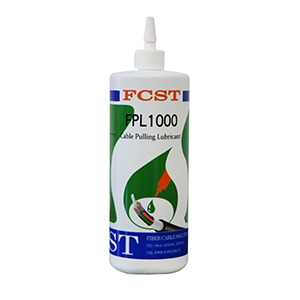
The product images you provided show a simple but highly effective bottle design:
Flexible, easy-squeeze bottle
Precision long-nozzle applicator
Tethered cap that never gets lost
Clean, controlled dispensing
Zero splashing or over-application
This matters on real job sites where technicians wear gloves, work in cramped spaces, or coat ducts above shoulder height. The lubricant’s viscosity (160 ± 10 MPa·s) ensures that it flows smoothly but stays where it is applied, reducing waste and cleanup time.
Installers immediately feel the difference between a premium, technician-friendly bottle and the generic containers competitors often use.
6. Engineering Table: Lubricant Required Per 100 Meters of Microduct

This table is not merely data—it is a sign of product maturity. The lubricant is:
tested
quantified
consistent
engineering-ready
7. The Ultimate Buying Argument: Why Choose FBL1000
✔ Guaranteed 30% performance improvement
Faster cable movement. Longer blowing distance. Higher installation success rate.
✔ Eco-friendly & operator-safe formulation
Odorless, non-corrosive, non-irritating, water-based—ideal for modern compliance standards.
✔ Creates a micro-thin, long-lasting lubricity film
Maintains performance even after partial drying.
✔ Compatible with all common cable jackets
Reduces procurement complexity and risk.
✔ Cleaner, easier, more controlled application
Engineered bottle design saves time and avoids waste.
✔ Proven dosage guidelines for engineering teams
Clear, repeatable performance for any microduct size.
✔ Designed to perform in real outdoor, indoor, dusty, hot, or humid environments
Not just a lab formula—built for the field.
✔ Part of a full ecosystem of microduct accessories from FCST
Connectors, chambers, sealing solutions—providing complete compatibility and value.
8. Conclusion: The Lubricant Is the Real Engine Inside Every Microduct
In fiber blowing, compressed air supplies the power, the machine controls the pressure, and the duct provides the path. But none of these can overcome the hidden force of friction alone.
A premium blowing lubricant—especially one engineered like FBL1000—is the true invisible engine that:
allows the cable to glide
stabilizes pressure
improves distance
protects equipment
reduces risk and dramatically increases productivity
When installers pour lubricant into the duct, they are not adding a liquid.They are laying down a nanoscale highway—smooth, predictable, and optimized for speed.
Modern fiber deployment relies on science, not luck.And the right lubricant turns every installation into a reliable, high-performance process.
FCST - Better FTTx, Better Life.
At FCST, we manufacture top-quality microduct connector, microduct closure, telecom manhole chambers, Warning Nets and Locators and fiber splice boxes since 2003. Our products boast superior resistance to failure, corrosion, and deposits, and are designed for high performance in extreme temperatures. We prioritize sustainability with mechanical couplers and long-lasting durability.
FCST, aspires to a more connected world, believing everyone deserves access to high-speed broadband. We're dedicated to expanding globally, evolving our products, and tackling modern challenges with innovative solutions. As technology advances and connects billions more devices, FCST helps developing regions leapfrog outdated technologies with sustainable solutions, evolving from a small company to a global leader in future fiber cable needs.